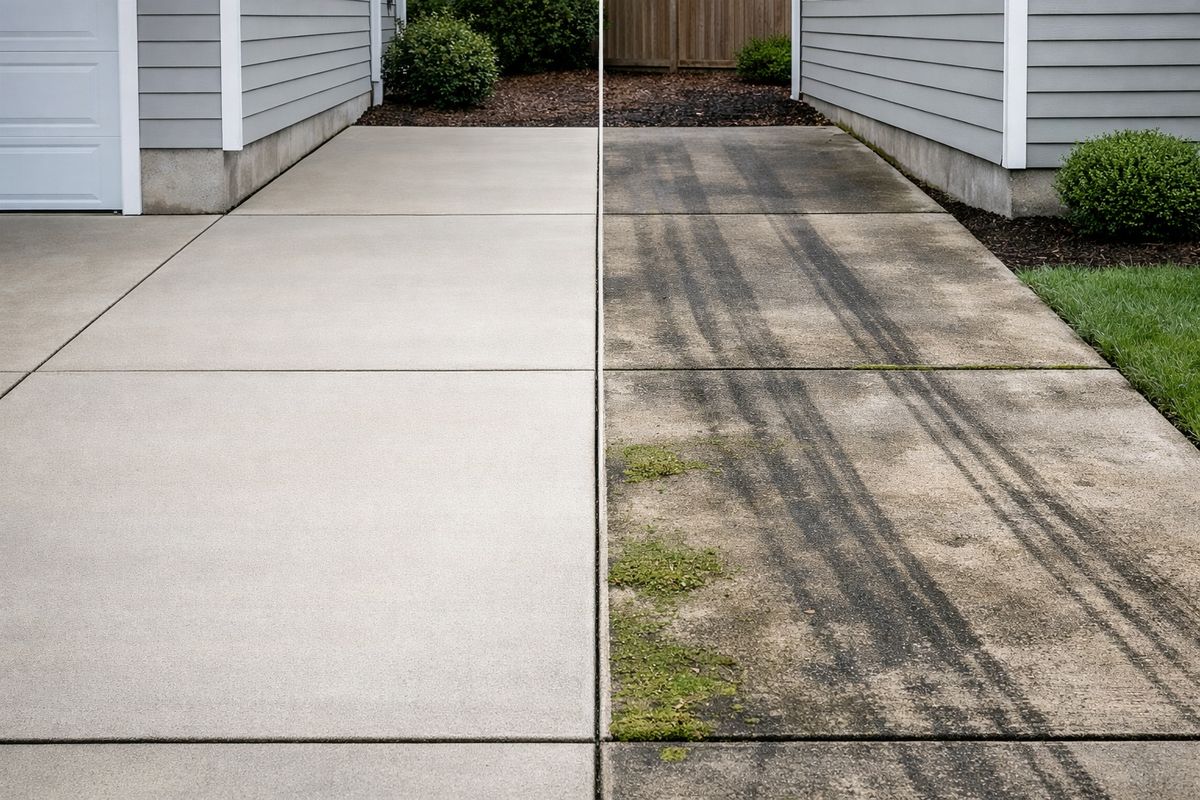
Driveway pressure washing looks simple until you notice your driveway at 8 a.m., when the sun hits it just right and every dark tire mark, green patch, and dingy streak suddenly shows up. A professional job should do more than blast dirt around. It should clean the surface evenly, treat the stains that actually can be improved, and leave your driveway looking fresher without chewing it up in the process.
Why Professional Driveway Pressure Washing Feels Different From a DIY Attempt
A lot of people picture driveway cleaning as nothing more than high-pressure water and a free afternoon. Here’s the thing: that is exactly how driveways get etched, striped, or left half-clean. Good driveway pressure washing is less about brute force and more about control.
The biggest difference is consistency. A pro is aiming for a driveway that looks evenly cleaned from the street, not just a few bright paths where the wand passed over the dirt. That even result matters because patchy cleaning stands out fast, especially on concrete.
There is also a safety angle that gets overlooked. Mold, algae, and moss are not just ugly. On a humid Tennessee morning, they can turn a sloped driveway or walkway into a slick mess. Removing that organic buildup improves footing, which matters whether you are backing out for work, carrying groceries, or greeting visitors at the front walk.
Then there is the surface itself. Too much pressure can scar concrete, rough up asphalt, or strip sand from paver joints. A professional job should protect the driveway while improving curb appeal. That is the real value. You are paying for judgment as much as cleaning.
What a Pro Looks At Before Any Water Starts
The walkthrough is where a good job begins. Before hoses come out, a solid company should look at the driveway material, the slope, where runoff will go, what kind of stains are present, whether there are existing cracks, what landscaping sits nearby, and how easy it is to access water.
That sounds basic, but it tells you a lot about how the work will go. If someone gives you a price in thirty seconds without looking at any of that, the service is probably going to be just as rushed. A careful estimate usually means a more careful cleaning.
The slope matters because dirty water has to go somewhere. Drainage matters because cleaners and loosened grime should not just pool against the garage or wash straight into a flower bed. Nearby plants matter because some cleaning products need to be applied carefully and rinsed thoroughly.
A real pro is matching the method to the surface and the conditions in front of your house, not using the exact same setup for every driveway on the schedule. That same kind of surface-specific thinking shows up in other exterior jobs too, especially when comparing low-pressure cleaning with traditional blasting.
Driveway Material Changes Everything
Concrete usually handles more aggressive cleaning than asphalt, but even concrete can be etched if pressure is too high or the nozzle is too close. Asphalt is softer and needs a gentler approach. Pavers add another layer because joint sand can be disturbed if the cleaning is too aggressive. Brick can chip or wear unevenly. Gravel is its own challenge entirely because the surface moves. Sealed driveways also need attention, since the wrong method can weaken or strip the protective layer.
That is why one-size-fits-all pressure washing is a bad sign. The right setup changes with the material. Pressure level, nozzle choice, cleaning solution, dwell time, and rinse technique should all shift based on what is actually underfoot.
This is not overcomplicating things. It is the difference between cleaning and damage. Research on driveway cleaning costs also points out that concrete and asphalt are usually cheaper to clean, while gravel and pavers tend to cost more because the work is more delicate and uneven (Angi).
Problem Spots Pros Notice Right Away
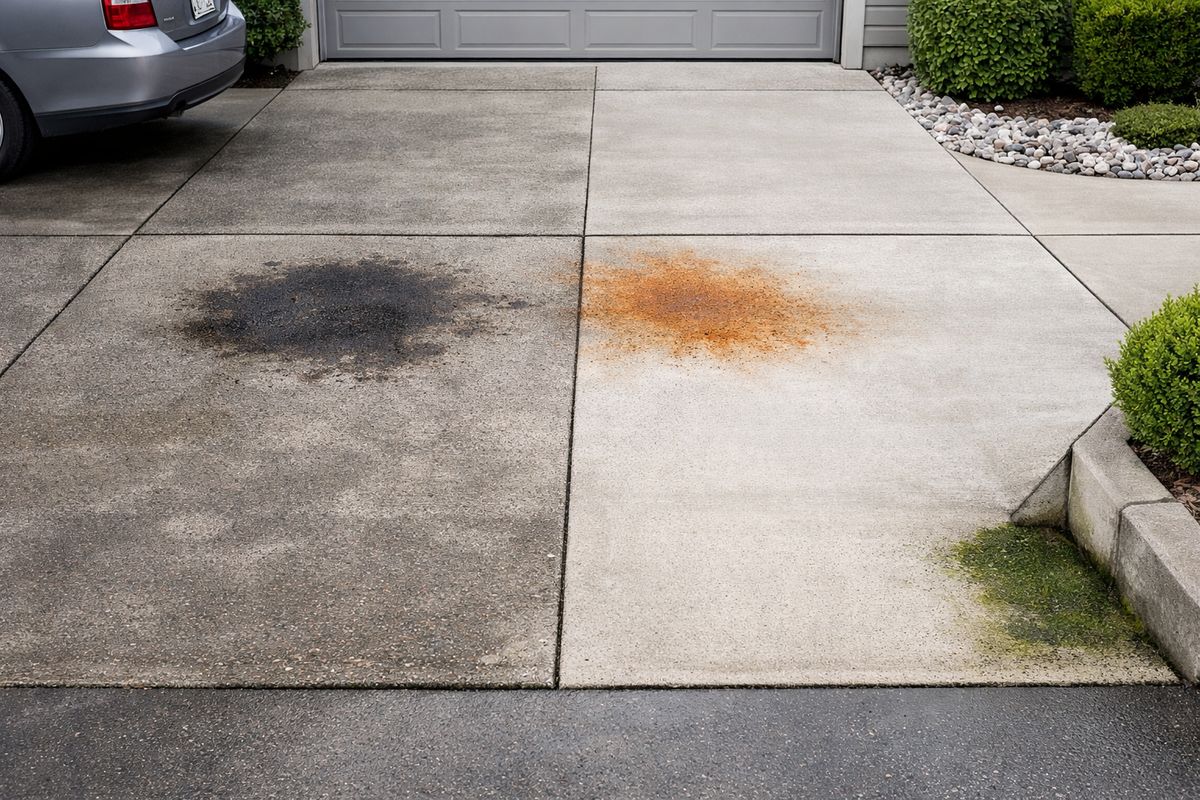
Some stains tell an obvious story. Oil drips near the parking spot. Rust marks beneath an old trailer hitch or sprinkler stain. Black tire tracks near the garage. Green algae in the shaded corner. Red clay after a storm. Mold and mildew in areas that stay damp for days.
A good pro should recognize those patterns quickly and tell you what is likely to happen. Dirt, mildew, algae, moss, and general grime usually improve a lot. Fresh oil often lifts better than old oil. Rust can be reduced with the right treatment, but it may not disappear. Deep tire marks may fade rather than vanish. Red clay can be stubborn because it stains, not just coats, the surface.
That honesty matters. If every stain is promised to disappear completely, expect disappointment.
How Pros Actually Clean a Driveway
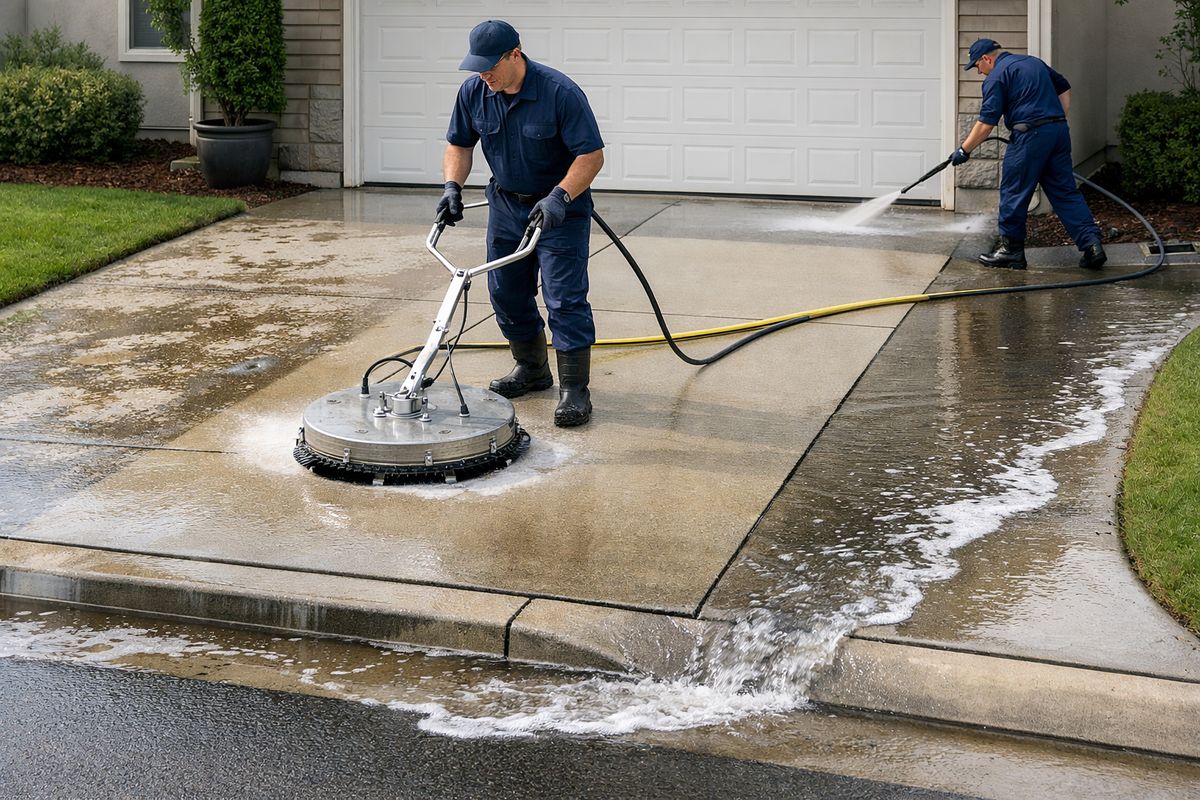
Service day usually follows a pretty clear flow. First comes setup. Then pretreatment for the stains and grime that need help. After that, the main cleaning happens with either a rotary surface cleaner, a wand, or both. Then come detail passes around edges, joints, garage doors, and transitions to sidewalks or curbs.
People also mix up pressure washing and power washing all the time. In everyday use, both terms often mean the same thing. Technically, power washing uses heated water and pressure washing uses unheated water. For most residential driveways, what matters is not the label. It is whether the crew uses the right pressure, the right cleaner, and the right tool for the surface.
Pre-Treatment Comes First
Pretreatment is one of the biggest reasons a pro job looks different. Before the visible washing starts, a cleaning solution is often applied to loosen organic growth, break down grease, or help lift deep-set grime. That gives the surface a head start and reduces the temptation to overdo the pressure.
For algae, mildew, and moss, chemical treatment often does more of the heavy lifting than raw water pressure. For oil and grease, spot treatment matters even more. Spraying the whole driveway and hoping for the best is rarely enough.
You should also expect clear answers about product safety. If grass borders the driveway, if pets use the yard, or if runoff could reach planting beds, ask what is being applied and how it is handled. A careful company should be able to explain that plainly, without hiding behind vague phrases like “green” or “eco-friendly.” Interest in water-efficient cleaning has been rising for exactly this reason, because people want effective cleaning without unnecessary waste.
Surface Cleaners vs. Wand Washing
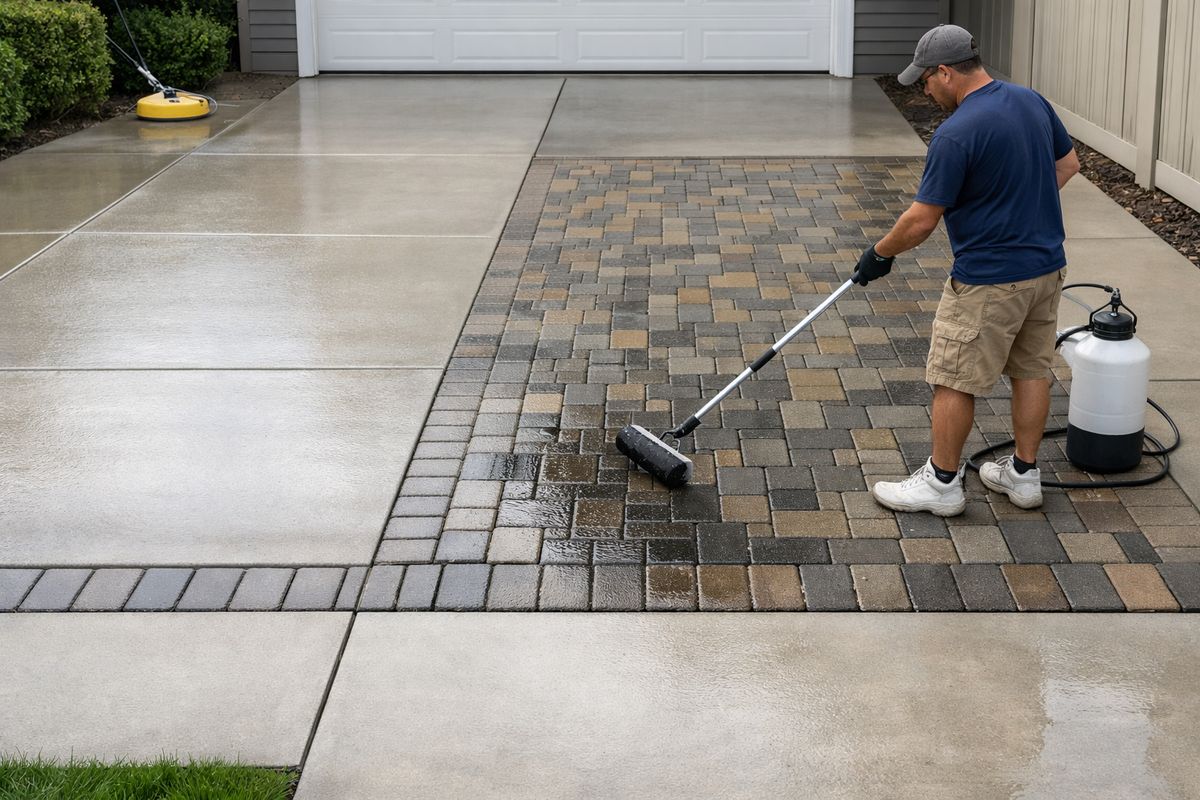
For most flat driveway surfaces, a pro will usually rely on a surface cleaner. This tool looks a bit like a round disc that glides over the concrete while spinning jets underneath. It cleans evenly and much faster than a standard wand.
Why does that matter? Because the surface cleaner reduces zebra striping, those obvious lighter and darker bands that happen when someone cleans with a wand in overlapping passes but cannot keep the spacing perfectly even. You have probably seen that look before. It screams rushed job.
A wand still has its place. It is useful for tight areas, stubborn spots, corners, and detail work. But for broad flat sections, the surface cleaner is usually what gives the driveway that smooth, uniform finish.
Edges, Joints, and Detail Work
This is where a job starts to look professional instead of merely wet. The clean line along the garage threshold, the dirt removed from the curb edge, the buildup flushed out of expansion joints, the blending where the driveway meets the sidewalk, those small areas make a big visual difference.
Detail work also helps avoid that awkward outcome where the center looks brighter but the edges stay dark. On pavers, detail work may include extra care around joints. On concrete, it may mean treating the border where runoff leaves a grime line. Around garage doors, it means cleaning without blasting water where it does not belong.
If you want a sense of how broad service expectations should look for exterior cleaning in general, what a standard exterior cleaning visit includes helps put driveway service in context.
What Results You Can Realistically Expect
This is the part most people want sugarcoated, but honest expectations save a lot of frustration. A good driveway cleaning can make a dramatic difference. It can also leave behind traces of old damage or staining that no amount of washing can erase.
Age matters. Surface condition matters. The type of stain matters. A driveway that has gone four years without cleaning, under tree shade, through heavy pollen seasons and Tennessee humidity, will not respond the same way as a newer driveway cleaned every year.
The goal is improvement you can clearly see from the street and up close. In many cases, that improvement is dramatic. Just do not confuse cleaning with restoration.
What Usually Improves Fast
General dirt usually lifts well. So do pollen film, mildew, algae, moss, and everyday discoloration. If your driveway has that gray-green cast or a dingy look that makes the whole front of the property seem tired, professional cleaning often changes that quickly.
This is especially true in humid areas where organic growth comes back fast. Removing moss and mold is not only about appearance. It also helps with traction. Even cost guides mention the safety benefit, since moss and mold removal can make the surface safer to walk on.
For homeowners thinking about resale, driveway cleaning also punches above its weight visually. A cleaner driveway makes the whole property look better cared for, which is why pre-sale curb appeal work often starts here.
What May Not Come Out Completely
Old oil is the classic example. If oil has soaked deep into porous concrete for years, it may lighten a lot without disappearing. Battery acid can leave discoloration that washing will not reverse. Rust may respond to targeted treatment, but ghosting can remain. Fertilizer stains and deep tire marks can also stick around, especially if heat has baked them into the surface.
That does not mean the service failed. It means the stain changed the material, not just the surface dirt on top of it. A good pro should tell you that before starting, not after the invoice is sent.
There is a big difference between “this should improve” and “this will be gone.” You want someone who knows the difference.
Existing Damage Won’t Be “Washed Away”
Pressure washing can reveal condition. It cannot repair it.
If your driveway has cracks, pitting, spalling, sinking sections, loose pavers, or broken edges, cleaning may actually make those issues easier to notice. Dirt often hides wear. Once the grime is gone, the true state of the surface is more visible.
That is not a bad thing. It helps you see what is cosmetic and what needs repair. But it is worth knowing upfront. If you expect washing to make structural problems disappear, you are setting the wrong goal.
How Long the Job Takes and What Service Day Looks Like
Most residential driveway appointments are pretty straightforward. The crew arrives, checks the area, connects to water, protects nearby surfaces as needed, applies pretreatment, cleans the driveway, handles detail work, rinses, and wraps up. The job is noisy while the equipment is running, and your driveway will be wet for a while afterward, but it is usually not an all-day disruption.
Water use depends on the equipment and method, and some crews are more efficient than others. Surface cleaners in particular can clean quickly and evenly without the endless open-hose effect many people picture. If you are booking a local service, you should expect a process similar to the Clarksville exterior cleaning approach, where the property is assessed first and the cleaning method is matched to the surface.
What You Should Do Before the Crew Arrives
Move vehicles out of the driveway before the appointment. If you can, clear portable items nearby such as planters, doormats, toys, or trash bins. Close garage and nearby house windows. Keep pets inside or well away from the work zone.
If a basketball hoop can be moved easily, that helps. If it cannot, just make sure the crew knows. The same goes for fragile edging, fresh mulch, or new plantings close to the concrete. Service goes smoother when the obstacles are known before water starts flying around.
How Long Cleaning and Drying Usually Take
Many residential driveway jobs take about one to two hours of active cleaning time, especially for standard suburban driveways in decent condition. Labor data often places that range at one to two hours, though larger or badly stained driveways can take longer.
Drying time depends on weather, shade, humidity, and airflow. On a warm sunny day, the surface may be mostly dry within a few hours. In shaded areas or muggy conditions, it can take longer. You usually do not need to stay off the driveway all day, but it is smart to wait until it is no longer visibly wet before parking on it again.
How Much Driveway Pressure Washing Usually Costs
For most homeowners, the easiest pricing benchmark is per square foot. Professional driveway pressure washing commonly falls around $0.30 to $0.55 per square foot, with many total projects landing between about $100 and $500 depending on size and condition. One widely cited estimate puts the average around $210 (Angi).
Those numbers are useful, but they are still just starting points. A lightly soiled straight concrete driveway is not priced the same way as a large paver drive with oil stains, heavy organic growth, and difficult access.
What Affects the Price
Square footage is the biggest driver. More surface means more time, more water, and more chemical use. Material matters too. Concrete and asphalt are usually less expensive to clean. Pavers and gravel often cost more because the work is slower and requires more care.
The level of buildup changes the quote. A driveway with basic dirt and pollen film is one thing. A driveway with old oil spots, algae in shaded sections, tire marks near the garage, and post-storm staining is another. Accessibility matters as well. Long hose runs, limited water access, steep grades, and crowded work areas all add friction.
Add-ons can change the number fast. Sealing, sidewalk cleaning, patio cleaning, or extra stain treatment may be worthwhile, but you want those costs spelled out clearly. If you want a wider look at pricing across services, what people usually pay for exterior cleaning gives helpful context.
Flat-Rate vs. Per-Square-Foot Quotes
Some companies price by square foot. Others use flat rates for common driveway sizes and conditions. Neither model is automatically better.
Per-square-foot pricing can feel more transparent, especially if your driveway is unusually small or large. Flat-rate pricing can be simpler when the company has standard packages and knows roughly how long the job should take. The catch is that two flat-rate quotes may include very different levels of service.
That is why you should compare scope, not just the number at the bottom. Does one quote include pretreatment, stain treatment, edge work, and rinse down while another is just a basic wash? If so, the higher quote may actually be the better value.
Why the Cheapest Quote Can Cost You More
This is worth saying plainly: the lowest bid is often the riskiest one.
Cheap driveway cleaning can mean rushed work, weak pretreatment, no stain-specific products, no real insurance, or sloppy technique. That is how you end up with stripes across the concrete, blown-out paver joints, or a driveway that still looks dirty around the edges. Research aimed at pressure washing businesses makes the same point from the other side: competing on price is a bad long-term strategy because quality and reliability matter more.
A fair quote should reflect time, technique, insurance, and the right cleaning products. Cheap is only cheap if nothing goes wrong.
Questions to Ask Before You Hire Anyone
You do not need an interrogation script. A few direct questions will tell you a lot very quickly.
Ask what type of surface you have and how the company plans to clean it. Ask what is included in the quote. Ask how stains will be treated. Ask what products will be used near grass and pets. Ask whether the company is insured.
If the answers are vague, rushed, or defensive, that is useful information.
Are You Insured and Experienced With My Surface Type?
Insurance matters because accidents happen. Hoses get dragged, surfaces react unexpectedly, overspray lands where it should not. But experience with your specific driveway type matters just as much.
Cleaning concrete is not the same as cleaning asphalt. Pavers are not the same as a garage floor. A crew that mainly washes siding or fences may not be the right fit for a stained driveway with organic buildup and a delicate edge. If you are sorting through local options, how to compare nearby crews can help you spot the difference between a polished estimate and real competence.
What Cleaning Products Do You Use?
This question is not about catching someone out. It is about understanding the process. A good answer should explain what gets used for organic growth, grease, or rust, and whether nearby plants and pets need any special precautions.
“Eco-friendly” is fine as a starting point, but it is not a real explanation by itself. You want plain language about what is being applied, why it is needed, and how runoff or overspray is handled.
Will You Treat Stains Separately?
If a driveway has oil spots, rust, algae patches, or heavy tire marks, those should not be treated as an afterthought. Ask what happens with each of those problem areas.
A careful company will usually explain that spot treatment may be separate from the general wash and that some stains are more likely to fade than vanish. That answer is a good sign because it means the company is paying attention to the surface in front of it.
Can You Explain Exactly What’s Included in the Quote?
This question saves more confusion than almost any other. You want to know if the estimate includes pretreatment, stain treatment, surface cleaning, edge work, rinse down, cleanup, and any optional sealing.
A quote that sounds higher at first may include all the work needed for a finished-looking result. A lower quote may be missing the parts that make the job actually look good.
Mistakes People Make When Booking Driveway Cleaning
Most bad experiences start before the service day. The mistake usually happens during booking.
The common pattern is simple: hire on price alone, assume every stain will vanish, skip the insurance question, and never ask how the surface will be cleaned. Then the result disappoints, even though the warning signs were there from the beginning.
Assuming More Pressure Means Better Cleaning
This is probably the biggest myth in the category. More pressure does not automatically mean better results. Sometimes it means more damage.
Too much pressure can etch concrete, scar asphalt, strip joint sand from pavers, or leave visible lap marks. The trick is controlled pressure plus the right cleaner and the right dwell time. Even broader pressure washer market research warns that extreme water pressure can cause severe damage when used without enough experience.
The driveway should look cleaner after the service, not rougher.
Waiting Until the Driveway Gets Really Bad
Heavy buildup is harder to remove, more expensive to treat, and more likely to leave behind staining. If you wait through several seasons of humidity, pollen, storms, and summer heat, grime has more time to settle in.
Regular cleaning is easier and usually cheaper than rescue cleaning. Not constantly, not obsessively, just often enough that buildup never gets deeply established. In Middle Tennessee, that often means paying attention after pollen season, wet stretches, and storm-heavy periods.
Forgetting About Runoff, Landscaping, and HOA Rules
Dirty water has to drain somewhere. Nearby flower beds can be affected if products are mishandled. Some neighborhoods also care a lot about appearance standards, access times, or noise windows.
If your driveway sits next to landscaping you care about, mention it. If your neighborhood has HOA expectations, keep those in mind. If runoff could move toward a patio, garage, or planted border, that should be part of the planning.
These are not glamorous details, but they are exactly the kind of details that separate smooth service from avoidable headaches.
Add-On Services Pros Often Recommend
Add-ons are not always upsells in the annoying sense. Sometimes they are simply the next logical step.
Once a driveway is clean, the contrast with nearby dirty surfaces becomes obvious. A bright driveway next to a stained sidewalk or dark garage apron can make the untouched areas stand out even more. That is why bundled services come up so often.
Sealing After Cleaning
Sealing can make sense for some concrete and many paver surfaces, especially if you want extra protection against moisture, staining, and weathering. On pavers, sealing may also help hold joint sand in place and deepen the finished look. On concrete, it can help reduce future staining and make maintenance easier.
The timing matters. Sealing usually happens only after the surface is fully clean and dry. If someone wants to seal immediately over a damp or still-dirty driveway, that is a red flag.
Sidewalk, Patio, and Garage Apron Cleaning
These areas are often cleaned together because they visually connect. Your eye does not stop at the driveway. It takes in the whole front approach, the walkway, the apron at the garage, and sometimes the front patio. Cleaning one and not the others can look a little like washing one shoe.
Bundled service can also save money compared with booking each area separately, especially when the crew is already on site with water, equipment, and cleaning products.
Soft Washing Nearby Surfaces
Not everything around the driveway should be cleaned with high pressure. Siding, roofing, painted trim, and other delicate surfaces often need soft washing instead, which means lower pressure plus cleaning solution doing most of the work.
This is why some companies suggest cleaning the whole front entry area, not just the driveway. If the driveway is bright but the siding above it is streaked with mildew, the overall result still feels unfinished. If you want the quick version of when that lower-pressure method makes more sense, where gentle exterior cleaning works better is worth reading.
Residential vs. Commercial Driveway and Lot Cleaning
The same basic principles apply across property types, but the expectations change depending on what the property is for.
A homeowner usually cares most about curb appeal, safety, and stain reduction. A storefront or property manager also cares about scheduling, traffic flow, repeat maintenance, and presentation during business hours. A contractor may be focused on surface prep before another service begins.
What Homeowners Usually Want
For most homes, the goal is simple: a cleaner-looking property without damage. You want the driveway to stop dragging down the look of the front yard. You want slippery green buildup gone. You want guests, neighbors, or potential buyers to see a well-kept home rather than a stained slab leading to the garage.
Common triggers are spring cleanup, summer entertaining, pre-sale photos, or just reaching that point where the driveway suddenly looks older than the house. That happens a lot after long humid stretches and pollen-heavy seasons.
What Property Managers and Storefront Owners Usually Need
Commercial cleaning is more about operations. You may need work done before opening, after closing, or in stages that avoid disrupting traffic. Entrances, parking areas, and high-visibility zones usually matter most. Repeat scheduling matters too, because one cleaning rarely keeps a commercial property looking sharp for long.
Industry reporting has noted that commercial accounts and property managers are often the more valuable long-term segment for pressure washing companies, which is one reason scheduling consistency and professionalism matter so much in that space.
What Contractors Need Before Paint or Other Work
For contractors, driveway and hardscape cleaning is often prep. It clears away dirt, organic growth, and loose contamination before sealing, striping, repairs, coatings, or nearby exterior painting begins.
In that setting, the best pressure washing job is the one that leaves the surface properly cleaned and ready for the next step without causing fresh damage that slows the project down. It is less about cosmetic wow and more about setting up clean, reliable conditions for the work that follows.
How Often You Should Have Your Driveway Cleaned
There is no magic schedule that fits every property. The right frequency depends on climate, shade, traffic, tree cover, driveway material, and how quickly grime builds up around your home or building.
For some properties, once a year keeps things in good shape. For others, especially shaded or humid spots, twice a year makes more sense. The right rule is less about the calendar and more about the condition you can actually see.
Homes in Humid, Pollen-Heavy Areas
In places like Middle Tennessee, humidity does half the scheduling for you. Moisture encourages algae and mildew, pollen coats surfaces heavily in season, and storms leave behind extra grime. If your driveway sits in partial shade or under trees, buildup can happen surprisingly fast.
That same climate pattern affects the house too, which is why how often Tennessee homes need washing often lines up with driveway maintenance decisions. If the siding and driveway are both looking tired at the same time, there is usually a reason.
Signs It’s Time to Schedule Service
You usually know before you consciously admit it. The driveway starts looking darker than it used to. Green patches show up along the edges. Tire marks become obvious. The concrete looks dull or yellowed. After rain, a section feels slick underfoot.
Those are all signs it is time. So is the plain old dingy look that makes the front of the property feel neglected, even when the lawn is trimmed and the porch looks fine.
How to Tell You Hired the Right Pro
You should feel the difference before the cleaning even starts. Good communication, realistic expectations, and surface-specific answers are usually visible during the estimate. Then service day should confirm it.
A solid pro is not just trying to finish fast. The job should look thoughtful from start to finish.
Green Flags During the Estimate
Prompt replies are a good start. So is a clear explanation of what will be cleaned, what stains may remain, and how the surface will be handled. Proof of insurance should be available without awkwardness. Answers about products and process should be straightforward, not evasive.
It also helps when the estimate feels specific to your driveway rather than copied and pasted. If the slope, stains, material, and surrounding landscaping are mentioned, that usually means the job has actually been assessed.
Green Flags on Service Day
Professionalism is pretty easy to spot in real life. Nearby areas are protected when needed. Equipment matches the job. Cleaning is even, not rushed. Detail work gets done around edges and transitions. The site is left tidy.
The crew should not disappear the second the driveway is wet. The result should look finished, not just sprayed.
One Simple Next Step Before You Book
Before you ask for quotes, walk your driveway once and make three quick notes: the surface type, the stains you see, and the worst problem spots. That tiny bit of prep makes it much easier to compare estimates fairly.
It also helps you avoid vague conversations and get straight to the useful part, which is whether the company understands exactly what your driveway needs. Try that before you book anything.
Frequently Asked Questions
Is driveway pressure washing safe for all driveway materials?
Not with the exact same method. Concrete, asphalt, pavers, brick, gravel, and sealed surfaces all need different handling. The service is safe when pressure, cleaners, and tools are matched to the material.
Can driveway pressure washing remove old oil stains completely?
Sometimes, but not always. Fresh or moderate oil stains often improve a lot. Older stains that have soaked deep into porous concrete may lighten without disappearing fully.
Do you need to be home during the service?
Usually not for the full appointment, as long as access, water, and scheduling details are handled ahead of time. Your vehicles should be moved first, and any special concerns about pets, gates, or landscaping should be shared before the crew arrives.
How soon can you drive on the driveway after cleaning?
Usually once the surface is no longer visibly wet. On warm sunny days, that may be a few hours. In shade or high humidity, drying can take longer.
Is pressure washing the same as soft washing?
No. Pressure washing uses stronger pressure for hard surfaces like concrete. Soft washing uses lower pressure and relies more on cleaning solution, which is better for delicate surfaces such as siding or some painted areas.
Should you seal the driveway after pressure washing?
Sometimes. Sealing can be a smart follow-up for concrete and pavers if you want added stain resistance and easier maintenance. It should happen only after the surface is fully clean and dry.