If you have ever looked up pressure washing cost and found ten wildly different numbers, you are not imagining it. A basic driveway cleanup and a full exterior wash can live in completely different price ranges, so the only useful way to think about cost is by job type, surface, and how much work the cleaning actually takes.
What Pressure Washing Usually Costs in Real Life
There is no single magic number for pressure washing. Most jobs are priced around what needs cleaning, how large it is, how dirty it is, how easy it is to reach, and whether the right method is standard pressure washing or soft washing. That is why one neighbor pays a couple hundred dollars for a driveway while another gets a quote that is twice that for a two-story home with mildew on the siding.
For a rough benchmark, the average cost to pressure wash a house is about $311, but that average hides a lot. National ranges often land somewhere between $100 and $703 for residential work, and broader house-washing quotes commonly fall between $212 and $448 for simpler jobs. In real life, your final number usually lands where your property sits between “easy and routine” and “awkward and stain-heavy.”
Typical price ranges you’ll see
Per-square-foot pricing for residential jobs usually falls around $0.10 to $0.50. Smaller areas tend to sit at the higher end because setup, travel, and cleanup still take time. Larger jobs often come down a bit per square foot because the crew can spread those fixed costs across more area.
A typical driveway often runs $100 to $250. Patios and decks commonly cost $100 to $200. Fences are often $150 to $300. Gutters may be $50 to $150 for exterior cleaning, while roof soft washing usually falls around $300 to $700 nationally, with some jobs climbing higher based on roof size and complexity.
Why one quote can be double another
Quote differences are normal. That is not automatically a red flag.
A one-story vinyl-sided home with easy water access and light dirt is fast to clean. A tall home with painted wood, steep rooflines, narrow side yards, algae streaks, and flower beds that need protection is not. Labor time changes, risk changes, chemical use changes, and insurance exposure changes too. Local competition also matters. In crowded markets, some companies price aggressively to win work, while others build in higher overhead, marketing, and insurance costs.
The Biggest Things That Change Your Price
Before you request quotes, it helps to know what actually moves the price. Square footage matters, but complexity matters more than most people expect.
Surface type: concrete, siding, wood, brick, roof
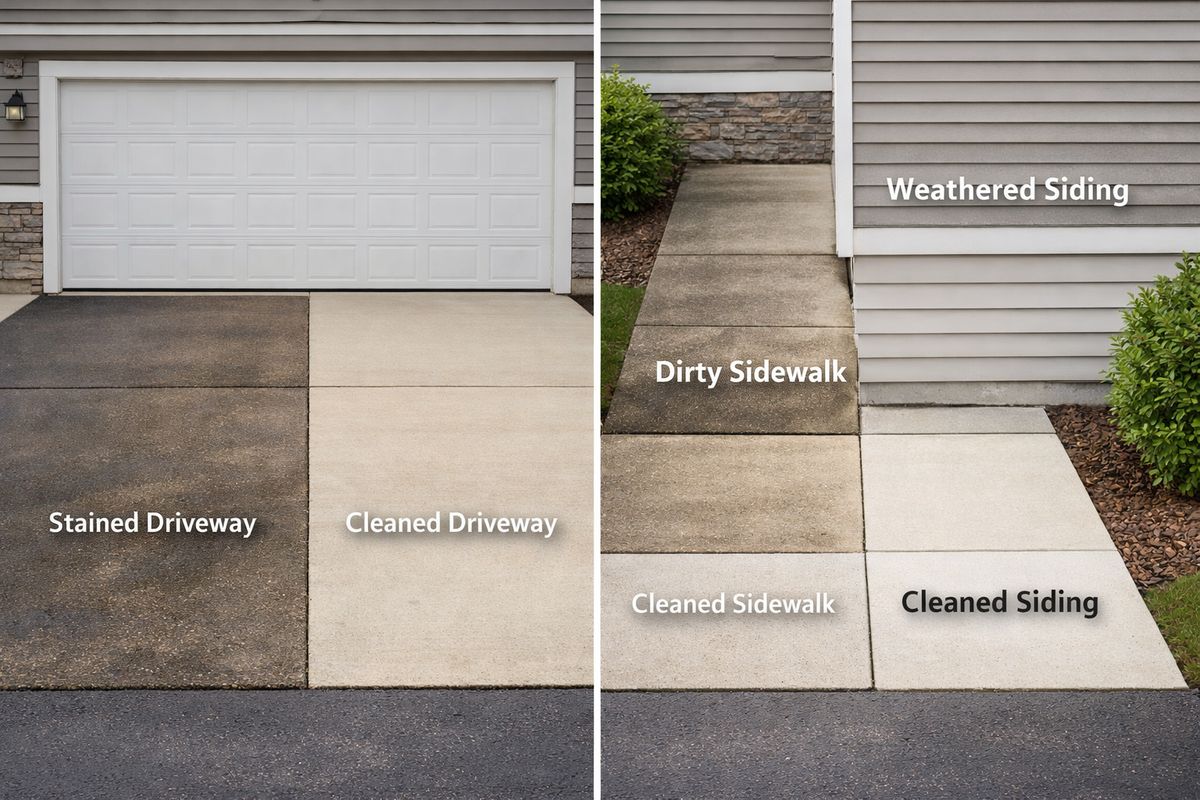
Concrete can usually handle higher pressure and faster cleaning. Wood often cannot. Brick may look tough, but older mortar can be more delicate than it seems. Vinyl siding usually needs a lower-pressure approach, especially around seams, trim, and windows. Roofs are their own category entirely, because shingles and specialty roofing materials often need soft washing instead of direct high pressure.
Material changes both speed and method. Angi’s pricing ranges reflect that, with brick often costing less per square foot than wood or stucco because gentler, slower work takes more time on sensitive surfaces.
Size and layout of the area
Bigger areas cost more, but awkward layouts can matter just as much. A straight driveway is easier than a long curved one with attached walkways. A compact patio is simpler than a wraparound patio with steps, railings, furniture to move, and tight corners. Fences can look modest from the street and still turn into a long labor-heavy job once every panel and both sides are included.
That is why measuring the obvious area only tells part of the story. Layout affects setup time, hose management, cleanup, and how quickly a crew can work.
Height, access, and safety risk
This is where pricing jumps fast. One-story homes often fall in a much lower range than two-story and three-story homes because ladders, safety gear, and slower working speeds all add labor. Angi estimates one-story homes at $150 to $1,000, two-story homes at $400 to $1,400, and three-story homes at $700 to $1,800.
Access matters just as much as height. Tight side yards, locked gates, steep slopes, delicate landscaping, and screened-in areas all slow the job down. If you are comparing bids, this is one reason a crew that actually visited the property may price differently than a quick online estimate.
Dirt level, stains, mold, and algae
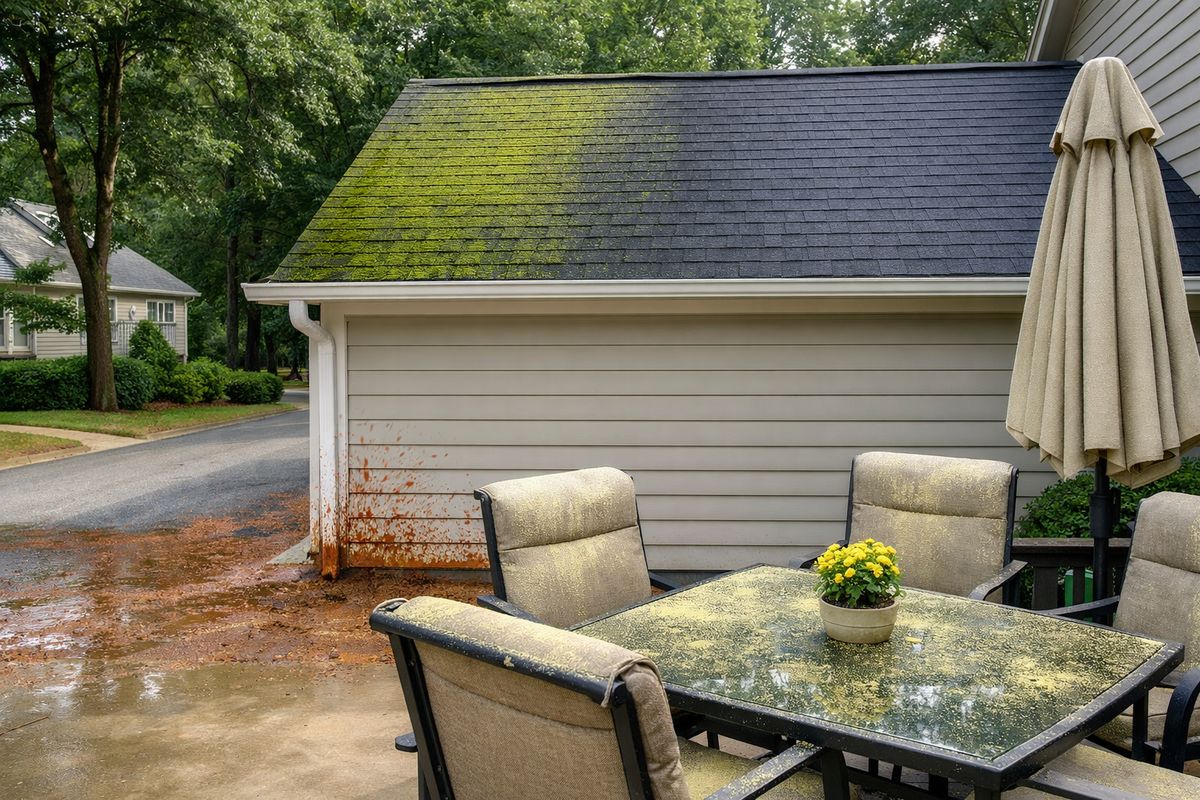
A dusty surface is one thing. Black algae streaks, rust drips, oil spots, and mildew are another.
In Clarksville and surrounding parts of Middle Tennessee, humid summers and heavy pollen seasons can turn a simple wash into a more treatment-heavy job. Mold and algae often need dwell time, which just means the cleaner has to sit on the surface and do its work before rinsing. Oil and rust usually need specialty products. If you are dealing with a listing photo deadline in a neighborhood near Rossview or Sango, buildup that looked minor from the sidewalk can suddenly matter a lot once every stain shows up in bright sun.
Pressure Washing vs. Soft Washing: Why the Method Changes the Bill
Pressure washing and soft washing are not interchangeable. More pressure is not better. It is just one tool.
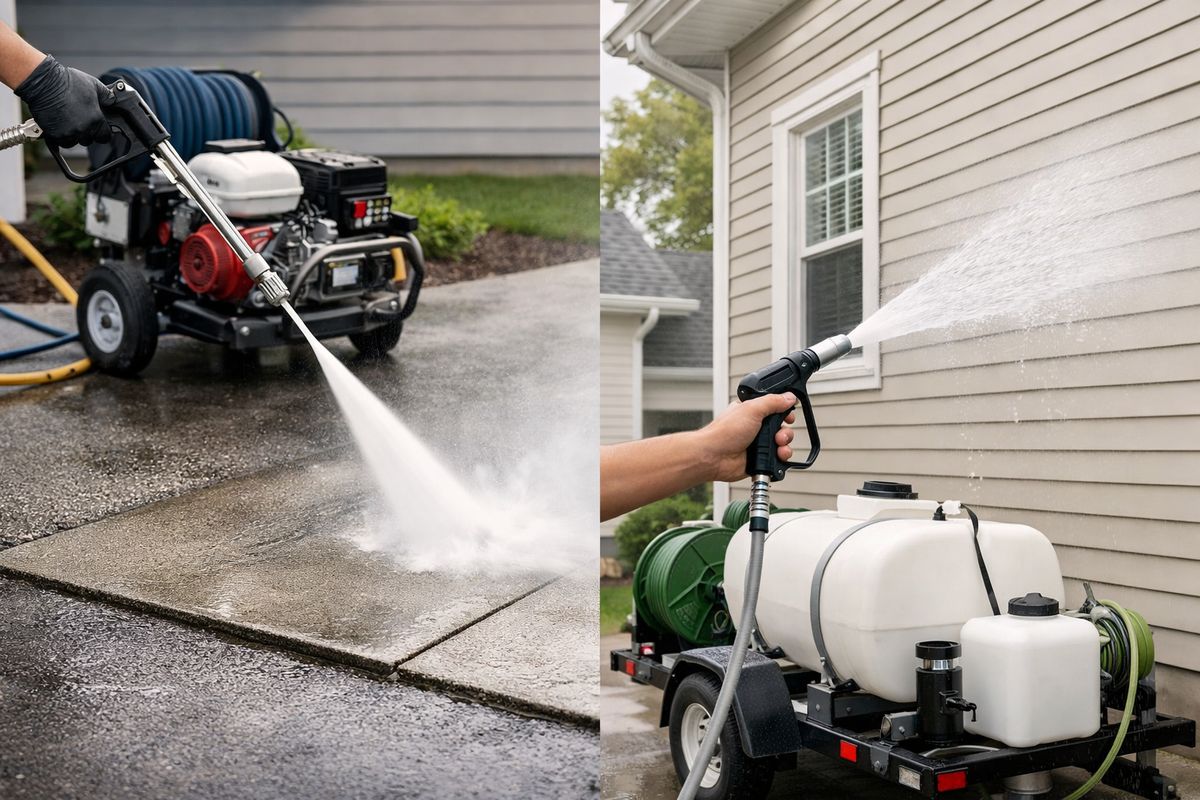
Standard pressure washing uses higher water pressure to break up dirt and grime on harder surfaces. Soft washing uses lower pressure plus cleaning solutions to kill algae, loosen organic buildup, and rinse surfaces safely. If you want a deeper breakdown, it helps to understand how the two cleaning methods differ before comparing estimates.
When standard pressure washing makes sense
Pressure washing works well on durable surfaces like concrete driveways, sidewalks, curbs, some pavers, and certain hardscape areas. These surfaces usually benefit from stronger mechanical cleaning, especially when dirt is surface-level rather than deeply embedded.
This method is often faster on flat concrete, which is one reason driveway and walkway cleaning can be fairly affordable when the staining is light.
When soft washing is the better call
Soft washing is usually the better choice for roofs, painted siding, vinyl, stucco, and other surfaces that can be damaged by aggressive pressure. Roof cleaning especially tends to fall into this category. Nationally, roof soft washing commonly lands around $300 to $700, while more complex roof jobs can push toward $900 or more depending on square footage and material.
For house exteriors, many companies use soft washing on siding because it cleans without forcing water behind panels or stripping paint. If your concern is exterior walls rather than concrete, cleaning siding with a gentler approach is often the safer bet.
The cost of getting the method wrong
This is where cheap pricing gets expensive fast. Too much pressure can etch concrete, scar wood grain, gouge deck boards, force water behind siding, loosen shingles, and even contribute to broken window seals. You are not just paying for spray time. You are paying for judgment.
That is why the lowest quote deserves a second look, especially if it skips method details. A contractor who plans to use one aggressive approach on every surface is not saving you money. That bid is just leaving the risk in your yard.
What Homeowners Pay by Project Type
This is the part most homeowners actually want: realistic ranges for common jobs.
House washing
A small one-story house may cost around $150 to $750, depending on material, dirt level, and whether the quote covers siding only or the broader exterior envelope. A two-story house often lands around $400 to $1,400. Three-story homes usually cost more because access and safety change everything.
Also watch the scope. “House wash” sometimes means siding only. Other times it includes soffits, fascia, exterior gutters, trim, porches, and basic spider web removal. If you are comparing services, what is included in a house exterior cleaning quote matters as much as the total price.
Driveways, sidewalks, and concrete
Driveways usually run $100 to $250, and per-square-foot pricing often falls around $0.20 to $0.40 for standard concrete. A 500-square-foot driveway often lands around $150 to $250 nationally. Decorative concrete, sealed surfaces, heavy buildup, or stain treatment can raise that.
Walkways are often bundled with the driveway for a better overall rate. If you want to know what a pro usually includes, what happens during a concrete cleaning visit can make quotes easier to compare.
Patios, decks, and fences
Patios often cost $100 to $200, but material changes everything. Concrete patios are usually simpler than wood or composite decks. Wood decks need more care because pressure that is too high can fuzz the surface, scar the grain, or create problems before staining. Fences are labor-heavy because cleaning often means both sides, posts, corners, and awkward access around landscaping.
If the goal is paint or stain prep, expect a premium. Pre-paint or pre-stain washing often costs more because the cleanliness standard is higher and damage prevention matters more.
Roofs and gutters
Roof cleaning is usually one of the higher-ticket residential exterior jobs. Roof soft washing commonly runs $300 to $700, while many homeowners pay around $600 for an average roof. Larger roofs, steeper pitches, complex valleys, and delicate roofing materials all push the price up.
Gutters are a separate line item on many estimates. Exterior gutter brightening or face cleaning often runs $50 to $150. Full interior gutter cleaning can be quoted separately, so it is worth checking whether “gutters included” means cosmetic exterior cleaning or debris removal too.
How Pricing Works: Per Square Foot, Flat Rate, or Custom Quote
A quote feels less mysterious once you know how it is built.
Per-square-foot pricing
Per-square-foot pricing is common for houses, driveways, patios, and other measurable surfaces. The usual residential range is $0.10 to $0.50 per square foot, though smaller jobs can feel higher because minimum charges still apply. Larger projects often get a lower effective rate because setup time gets spread across more work.
Minimum service charges and flat-rate jobs
Even a tiny job has travel time, equipment unloading, hose setup, chemical prep, and cleanup. That is why many companies have a minimum service charge. In practice, a small patio or short walkway may not be billed strictly by size. It may be priced as a flat-rate minimum instead.
This catches homeowners off guard all the time. A 150-square-foot pad does not take much spray time, but the appointment still takes a crew out to your home for part of the day.
Add-ons that raise the total
The common extras are pretty predictable: detergent treatment, rust removal, oil stain treatment, hard water stain cleanup, sealing prep, gutter brightening, and expedited scheduling. Some stains need specialty chemicals or more than one treatment pass. That changes labor and material cost quickly.
If your quote includes none of this detail, it is too vague. Good estimates usually spell out what is basic cleaning and what counts as extra work.
DIY vs. Hiring a Pro
DIY pressure washing can save money, but only on the right kind of job.
What DIY really costs
A consumer-grade pressure washer rental usually costs about $40 to $100 per day. That sounds appealing until you add fuel or electricity, hoses, detergent, attachments, transportation, setup, and your time. For many homeowners, the real cost is a Saturday that disappears faster than expected.
And the machine matters. Consumer models are fine for light-duty cleaning, but they are not built like professional rigs. That is one reason rental machines cost $40 to $100 per day while pro service starts to make more sense once the job gets larger or stain treatment is involved.
When DIY is usually fine
DIY is usually fine for small, durable, easy-to-reach surfaces. Think a compact concrete pad, outdoor furniture, or a lightly soiled walkway where mistakes are less likely to cause expensive damage.
The catch is that “fine” does not always mean “best.” You can get acceptable results on flat concrete without much risk. That is different from doing a whole house well.
When it’s worth paying for a pro
Roofs, upper-story siding, painted surfaces, decks, and anything with mold, algae, oxidation, or stubborn stains are usually worth professional help. Safety is the obvious reason, but surface damage is the bigger money issue. A cheap rental and one wrong spray angle can create a repair bill that wipes out any savings.
If you are still sorting out what a real service visit should involve, what homeowners should expect from a professional crew is a useful baseline.
How to Compare Quotes Without Getting Burned
A good quote helps you compare value. A bad quote just gives you a number and hopes you stop asking questions.
What a good quote should include
A solid quote should spell out the surfaces included, the cleaning method, what stain treatment is or is not covered, whether chemicals are included, and what kind of protection is used around windows, plants, outlets, and nearby surfaces. It should also note whether your water supply is needed and whether minimum charges apply.
You do not need a ten-page contract. But you do need enough detail to know what you are buying.
Questions to ask before you book
Ask whether the company is insured. Ask whether soft washing is available for delicate surfaces. Ask what results are realistic for rust, oil, or deep organic staining. Ask whether the price includes detergent and treatment chemicals. Ask whether runoff and post-job cleanup are handled.
Those are normal questions, not picky ones. In a crowded local market, details are what separate a careful contractor from somebody with a machine and a Facebook page.
Red flags and common pricing traps
The big red flags are vague estimates, teaser prices that somehow never survive inspection, and bids that skip method details completely. Another common trap is quoting the cheapest possible version of a job, then piling on stain-treatment upsells once the crew arrives.
Local competition can create very wide price swings, which means a low number is not automatically fake. But if the quote feels thin on scope, chemicals, or method, be careful. Cheap is fine. Unclear is not.
What Pressure Washing Costs in Clarksville and Similar Markets
Clarksville pricing does not follow one fixed chart, but local conditions absolutely influence what you pay.
Why humidity, pollen, and HOA standards matter
Middle Tennessee humidity helps mildew and algae grow faster, especially on north-facing siding, shaded fences, and roofs under tree cover. Spring pollen piles onto horizontal surfaces and clings to exterior walls. Add in red clay splatter, summer storms, and neighborhood appearance standards, and exterior cleaning becomes less of a luxury and more of a maintenance cycle.
That means demand stays steady. If your home needs better presentation before listing, or you just want that cleaner look back, using exterior cleaning to boost first impressions often pays off faster than bigger cosmetic projects.
Seasonal demand and timing your service
Spring is busy. So is early summer, when patios, decks, and listing photos start calling for attention. Post-storm cleanup can create short-term demand spikes too. If you book during the rush, expect slower calendars and less wiggle room on pricing.
The good news is that slower periods can work in your favor. Early spring, late fall, or off-peak gaps between weather swings can sometimes get you faster scheduling and better bundled pricing, especially if you are combining more than one surface.
How to Get the Best Value for Your Money
The smartest way to save is not always to find the cheapest quote. It is to lower your cost per result.
Bundle the right surfaces
Bundling is one of the easiest ways to bring the effective price down. House, driveway, patio, and walkway cleaning done in one visit usually costs less than booking each piece separately weeks apart. Travel, setup, and cleanup only happen once, and many companies reward that with package pricing.
This is especially true when small jobs would otherwise hit a minimum service charge on their own.
Know when paying more is worth it
It is worth paying more for roofs, delicate siding, stain-heavy concrete, and any prep work before painting or staining. Those are the jobs where method matters most. Spending a bit more for the right chemicals, the safer technique, and a more careful crew is usually cheaper than fixing etched concrete or damaged wood later.
You are not paying extra for fancy branding. You are paying for lower risk and better results.
Try this before you request quotes
Before you start collecting estimates, measure the main surfaces, take a few clear photos of stains or algae, and decide exactly what you want cleaned now versus later. Then request side-by-side quotes using the same scope so you are actually comparing apples to apples.
That one step makes price shopping much easier, and it usually leads to better answers.
Frequently Asked Questions
How much does pressure washing cost for an average home?
For a typical house, many homeowners land somewhere between about $200 and $700, with national averages often around the low $300s. Your total depends on size, number of stories, siding type, and how much treatment the surface needs.
Why is roof cleaning more expensive than driveway cleaning?
Roofs usually need soft washing, specialized chemicals, slower application, and more safety precautions. Height, pitch, and roofing material also raise labor and risk, so the price is often much higher than a flat concrete surface.
Is pressure washing priced by square foot or by the job?
Both. Larger, easy-to-measure areas are often quoted by square foot, while smaller jobs may be priced with a flat minimum. Complex properties usually get a custom quote because layout, access, and stain level affect the real labor more than size alone.
Does soft washing cost more than pressure washing?
Sometimes, yes. Soft washing often uses more chemical treatment and more careful application, which can raise the price. But it is usually the right method for siding and roofs, and paying for the correct method is cheaper than paying for damage repair later.
Is DIY pressure washing cheaper?
It can be, but mostly for small concrete jobs that are easy to reach. Once you add rental cost, detergent, attachments, and your time, DIY stops looking like a bargain on bigger or more delicate surfaces.
How can you lower pressure washing cost without cutting corners?
Bundle multiple surfaces into one visit, book before peak seasonal demand if possible, and request detailed quotes with the same scope from at least three companies. That gives you a fair comparison and helps you spot where a higher quote actually includes more value.